Custom bubble mailers are the first physical thing a customer touches after they hit “buy,” which makes the plain brown padded envelope one of the cheapest branding upgrades a small e-commerce shop can make. Instead of a stock mailer with a shipping label slapped on top, a printed one carries your logo, your colors, and often a reorder link or unboxing note, for only a few cents more per unit than an unbranded bag.
The catch is that pricing, minimum order quantities, and turnaround times vary a lot between suppliers, and most sites don’t make the comparison easy. Order too few and you pay a steep per-unit premium; order too many and you’re storing a pallet of envelopes printed with last season’s logo. Below is what the numbers actually look like right now, so you can size an order before you start requesting quotes.
Source: Sticker Mule, PakFactory, and supplier sites listed above (accessed August 2026)
What custom bubble mailers actually cost
Price per mailer falls fast as order size grows, then flattens out. That’s typical of digital short-run printing: the setup and design cost gets spread over more units, but material and shipping costs stay roughly linear, so the savings taper off after a few thousand units.
Sticker Mule’s published pricing for custom bubble mailers is a useful benchmark because it’s transparent and public rather than quote-gated. At 50 units, a mailer runs about $1.68; by 1,000 units that’s down to $0.78; by 5,000 units it’s $0.59. If your order volume is genuinely small — under a few hundred parcels a month — the jump from 50 to 500 units is where most of the savings sit, and it’s worth ordering ahead rather than reordering constantly at the small-batch rate.
Minimum order quantities vary more than people expect
Not every supplier will even take a small order for custom bubble mailers. The MOQ split roughly falls into two camps: printers built around short digital runs for individual sellers, and packaging manufacturers built around large flexographic runs for brands already shipping thousands of units a month.
If you’re testing a design or a new product line, look for the low end of that range first. Committing to 5,000 printed mailers before you’ve validated packaging, sizing, and order volume is a common way to end up with unusable inventory when a design or size needs to change.
| Supplier | Minimum Order Quantity |
|---|---|
| Sticker Mule | 10 units |
| PRINT.COM | 25 units |
| RacetopPrint | 50 units |
| Teal Packaging | 50 units |
| OXO Packaging | 100 units |
| PlusPrinters | 100 units |
| MAILERS HQ | 250-500 units |
| PakFactory | 5,000 units |
Picking the right size before you order
Bubble mailers are sold by a size number rather than just dimensions, and the numbering isn’t intuitive if you haven’t ordered them before. The smallest common sizes are #000 (4″ x 8″ outside, roughly 3.75″ x 6.5″ usable), #00 (5″ x 10″ outside, about 4.5″ x 8.5″ usable), and #0 (6″ x 10″ outside, about 5.5″ x 8.5″ usable) — these three cover most jewelry, small apparel, cosmetics, and accessory shipments. Larger numbered sizes scale up from there for books, multi-item orders, and small boxed goods.
Measure your actual product plus packaging insert, not just the item itself. A mailer that’s too tight won’t seal cleanly over the bubble lining, and one that’s too large lets the product shift in transit even with padding, which is the most common damage complaint sellers report after switching to custom bubble mailers.
Poly-Bubble vs. Kraft-Bubble
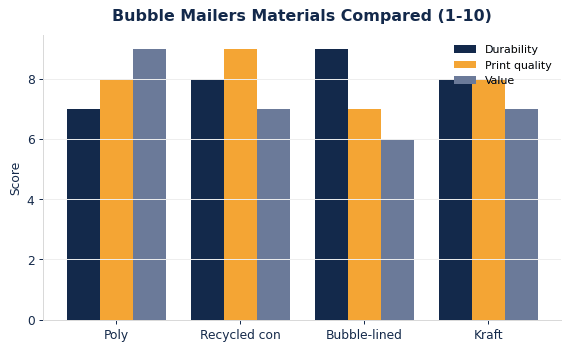
Most custom bubble mailers on the market now use a poly (plastic film) outer layer rather than paper kraft, because poly holds print color better, resists tearing and moisture, and self-seals with a adhesive strip. Kraft-paper bubble mailers still exist and read as more eco-conscious, but they generally cost more per unit and print less vividly, since ink sits differently on paper than on coated film.
Lead times: what to expect before you need stock
Turnaround time is where suppliers differ most, and it’s easy to underestimate if you’re used to ordering unbranded mailers that ship same-day from a warehouse. A custom print run has to go through proofing, printing, and often adhesive-strip application before it ships, and that adds real days to the timeline.
Sticker Mule advertises a 4-day turnaround with free shipping on its custom bubble mailers, which is unusually fast for a printed product. Most other custom packaging suppliers quote 7-15 business days for a standard run, and large or complex orders — bigger quantities, multiple ink colors, or a first-time die setup — can stretch to 21-30 days. If you’re ordering for a seasonal launch, work backward from your ship date and add a buffer; running out of branded mailers mid-launch usually means falling back to plain envelopes for the rest of the run.
Design specs that affect price and print quality
Full-color, full-bleed printing — ink that runs edge to edge with no white border — is standard at no added cost from most digital-print suppliers today, which wasn’t true a few years ago when extra colors or edge printing carried a surcharge. That said, a few things still move the price or the proof quality up or down.
Printing on both sides costs more than a single logo panel on the front. Metallic or spot-color inks, when offered, usually add a per-unit fee and a longer proofing step. And resolution matters more on a mailer than on a sticker: because the printable area is large, a low-resolution logo file that looks fine on a business card will visibly pixelate across an 8-10 inch panel, so send vector art or a high-resolution raster file when you submit a design.
What to have ready before you request a quote
Quotes move faster, and come back more accurate, when you can answer a few questions up front: your target quantity (and whether you’re testing a design or committing to a season’s supply), the mailer size that fits your product, whether you need one-side or two-side printing, and your ship-by date. Suppliers with published pricing calculators, like Sticker Mule, let you check most of this yourself before contacting anyone; suppliers that quote on request, which includes most bulk manufacturers, will ask for these same details anyway.
For a first order, it’s usually worth staying at the low end of a supplier’s MOQ even if the per-unit price is higher than a bulk run. Custom bubble mailers are cheap to test and expensive to overcommit to — a wrong size or a logo placement issue is a minor cost at 100 units and a real problem at 5,000.
Frequently asked questions
What is the minimum order quantity for custom bubble mailers?
It depends heavily on the supplier. Digital-print shops built for small sellers, like Sticker Mule, allow orders as low as 10 units. Mid-size printers commonly set a 50-100 unit minimum. Bulk packaging manufacturers such as PakFactory require 5,000 units, since their process relies on flexographic printing that only becomes cost-effective at high volume.
How much do custom bubble mailers cost per unit?
Based on Sticker Mule’s published pricing, expect around $1.68 per mailer at 50 units, dropping to about $0.89 at 500 units and $0.59 at 5,000 units. Bulk manufacturers with 5,000+ unit minimums often land under $0.20-0.30 per unit at their higher volumes, but you won’t see that price until you commit to the full minimum run.
How long does it take to get custom bubble mailers printed?
Standard turnaround across most custom packaging suppliers is 7-15 business days. Sticker Mule advertises a notably faster 4-day turnaround with free shipping. Larger orders, multi-color prints, or first-time die setups at bulk manufacturers can push lead time to 21-30 days, so plan seasonal orders well ahead of your ship date.
What size bubble mailer do I need?
Bubble mailers are labeled by size number rather than inches alone. The smallest common sizes are #000 (4″ x 8″ outside), #00 (5″ x 10″ outside), and #0 (6″ x 10″ outside), which cover most jewelry, apparel, and small accessory shipments. Measure your product plus any packaging insert before choosing a size — too tight and the mailer won’t seal cleanly, too loose and the product can shift in transit.
Is poly or kraft-paper better for a custom bubble mailer?
Poly (plastic film) bubble mailers are the current standard because they hold printed color more vividly, resist moisture and tearing, and self-seal with an adhesive strip. Kraft-paper bubble mailers read as more eco-friendly and are available from most of the same suppliers, but they typically cost more per unit and print less sharply since ink behaves differently on paper than on coated film.
The bottom line
The range in custom bubble mailers pricing and minimum order quantities isn’t arbitrary — it tracks the printing method each supplier uses, and that method is set by the volume they’re built to serve. If you’re shipping a few hundred orders a month, a low-MOQ digital printer will get you branded mailers faster and with less upfront commitment. If you’re already shipping thousands of units and know your size and design won’t change soon, a bulk manufacturer’s per-unit price becomes worth the higher minimum and longer lead time.
Either way, nail down your size, print sides, and ship-by date before requesting quotes — it’s the fastest way to get an accurate number back instead of a range.