Picking a bubble mailer looks like a one-number decision and is really a two-number decision. The size on the label tells you the outside of the envelope, but what matters is the usable space inside and the postage bracket that size and thickness land you in. Order by the label alone and you get products that will not slide in, or you overpay on every shipment because the mailer tipped into a higher rate. This is a size-by-size reference to the standard #000 through #7 ladder, plus the two hidden numbers that decide whether a size actually works for you.
How the #000 to #7 ladder is numbered
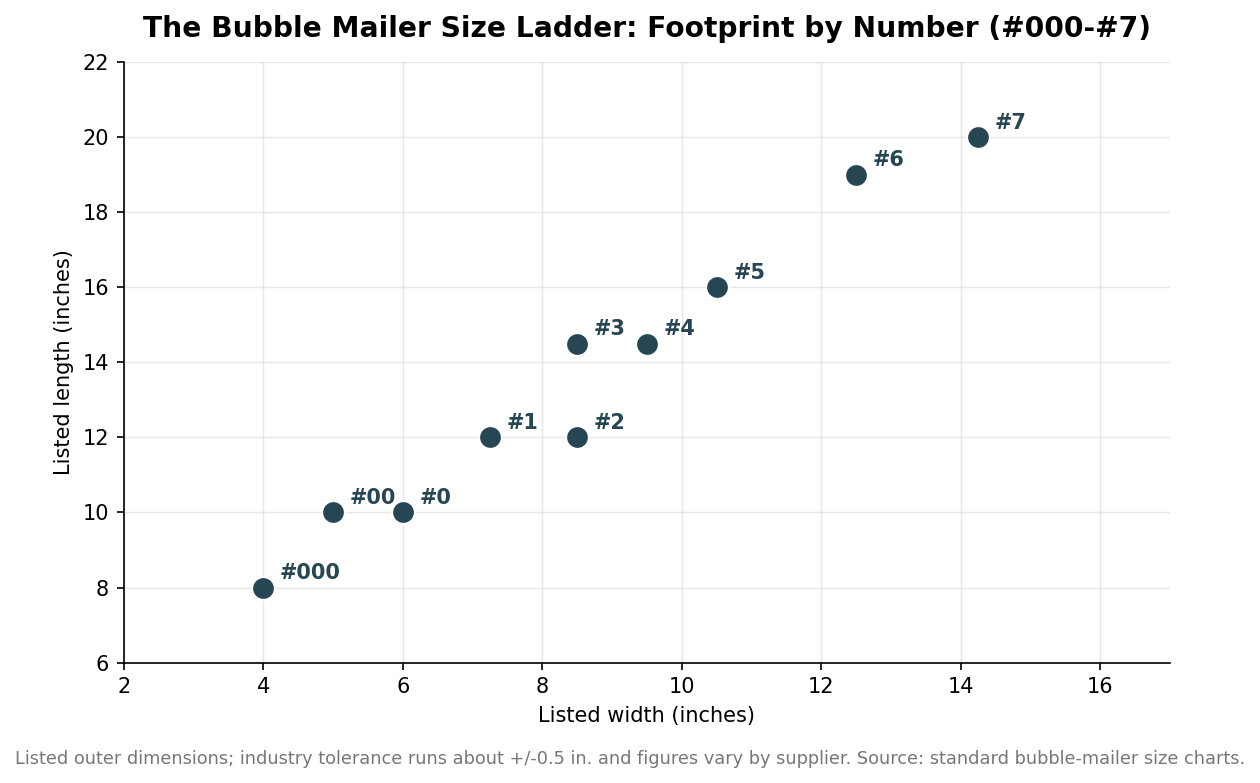
Bubble mailer sizes run on a numbered scale that gets larger as the number climbs, and the common lineup covers ten steps. #000 is the smallest at roughly 4 by 8 inches, sized for jewelry, USB drives, and small cosmetics. #00 (about 5 by 10) and #0 (about 6 by 10) fit phones, phone cases, sunglasses, and paperbacks. #1 (7.25 by 12) suits tablets and small folded apparel, while #2 (8.5 by 12) is the workhorse for documents, hardcover books, and a folded T-shirt. From there, #3 (8.5 by 14.5) and #4 (9.5 by 14.5) handle folded apparel, magazines, and posters; #5 (10.5 by 16) takes shoes, hoodies, and board games; and #6 (12.5 by 19) and #7 (14.25 by 20) cover jackets, larger apparel, and artwork. Treat those dimensions as the conventional listed sizes rather than exact law, because industry tolerance runs about half an inch either way and numbers vary a little from one supplier to the next. A few makers also stock in-between sizes such as a #CD envelope sized specifically for jewel cases, but the numbered ladder above covers the great majority of what you will ship, and learning it is enough to place a confident order.
The listed size is not the usable size
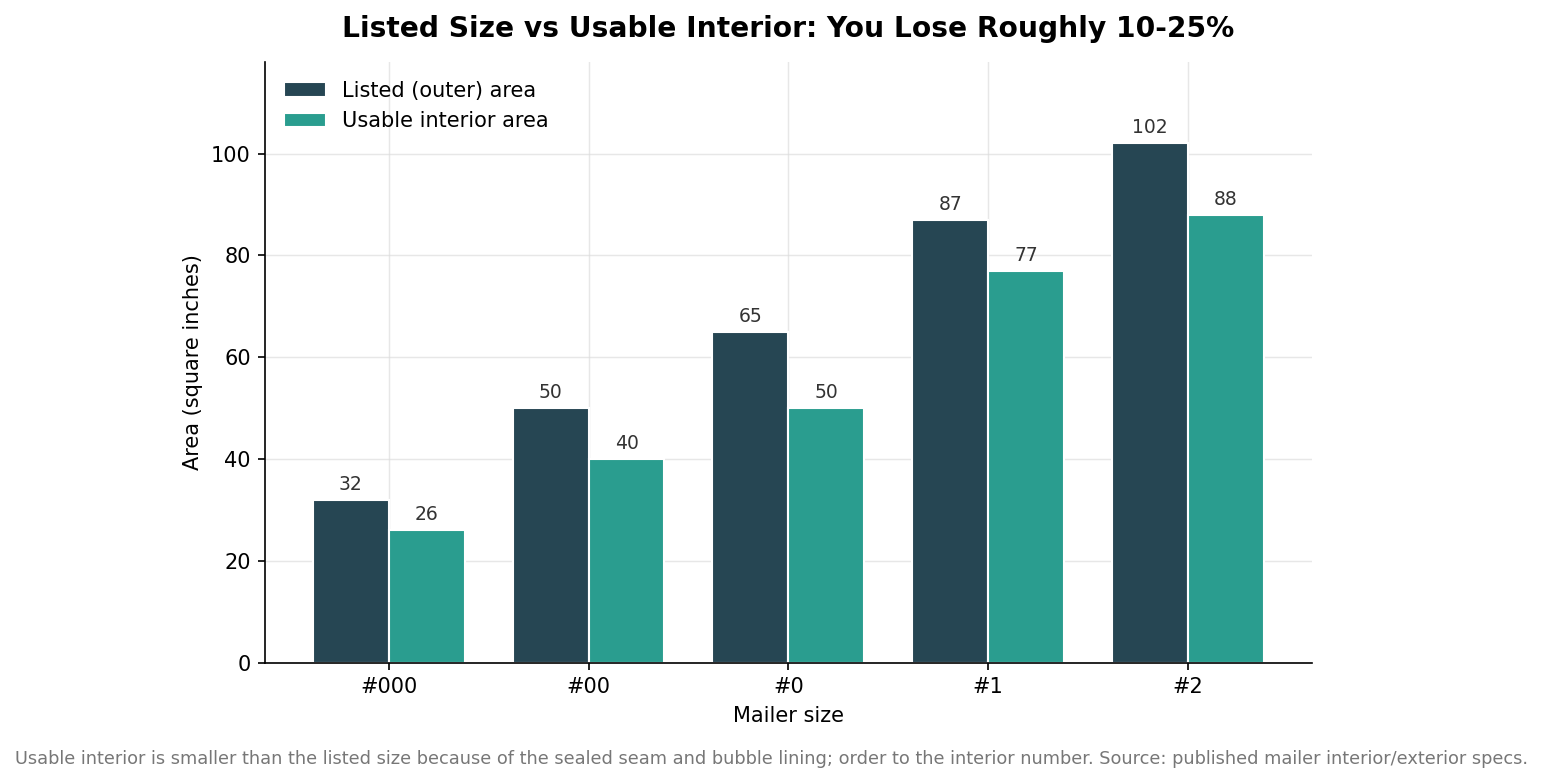
The single most common mistake is ordering to the printed dimensions. Every bubble mailer loses interior space to the sealed bottom seam and the bubble lining itself, so the room your product actually has is smaller than the label. As a rule of thumb the usable interior runs about a quarter inch to a full inch shorter in each direction. A #0 listed at 6.5 by 10, for example, gives roughly 5.5 by 9 inches of working space, and a #2 listed at 8.5 by 12 nets closer to 8 by 11. Expressed as area, you are typically giving up somewhere between ten and twenty-five percent of the footprint the label implies. The practical fix is to measure your product flat, add a small margin so it slides in without forcing the seal, and then match that figure to the interior dimension, not the size number on the box.
Size is also a postage decision
The dimension that quietly controls your shipping cost is thickness. USPS treats any envelope thicker than three-quarters of an inch, contents included, as a package rather than a flat or a letter, which changes how it is priced. Once you are in package territory, the two everyday options for a light mailer are First-Class Package Service, which as of 2026 starts around $4.09 for parcels up to 4 ounces and carries up to 13 ounces with tracking, and Ground Advantage, which starts near $4.09 for weights up to a pound. Priority Mail Flat Rate padded envelopes exist at about $12.95 retail but only make sense for heavier contents. The lesson for sizing is to buy the smallest mailer that comfortably fits, since an oversized envelope adds both bulk toward that three-quarter-inch line and weight toward the next price bracket. Crossing the 4-ounce mark is the threshold most sellers watch, because it is where a cheap shipment turns into a merely average one. These are indicative retail starting rates; your real cost depends on weight, zone, and any account discount.
Match the material to how it will be thrown away
Size decides fit and postage; material decides the unboxing feel and what your customer can do with the empty mailer, which increasingly shapes brand perception. Standard poly bubble mailers are lightweight and water-resistant but are not curbside recyclable; they go to store drop-off bins alongside plastic bags, identifiable by a #4 or LDPE marking. Kraft mailers with a bubble lining look like paper but fuse paper to plastic, and that fusion is exactly what recycling facilities cannot separate, so despite the paper exterior they usually are not curbside recyclable unless the layers peel cleanly apart. All-paper padded mailers are the exception that is fully curbside recyclable once you strip the tape and labels, at the cost of the waterproofing a poly mailer provides. If sustainability messaging matters to your buyers, choose the material deliberately and tell them how to dispose of it, because a mailer that ends up in the wrong bin undercuts the message on the outside. A simple line printed near the seal, telling the recipient whether to recycle at the curb or drop the film at a store bin, does more for that message than a vague recyclable logo, and it costs nothing to add to a custom print run.
Putting it together
A clean selection comes down to three moves. Measure the product and match it to the mailer’s interior dimension, not the label; keep the packed thickness under three-quarters of an inch and the weight under your target postage bracket; and pick a material whose end of life matches what you promise customers. Do that, and the number on the mailer stops being a guess and becomes a spec. The product fits on the first try, the postage prints at the rate you expected, and the envelope does its quiet job of arriving intact without costing more than the thing inside it.