For a store shipping apparel, jewelry, cosmetics, books, or small electronics, the package you choose is a pricing decision, not just a packing one. The same product can cost noticeably more to ship in a box than in a bubble mailer, and in 2026 two USPS rule changes have widened that gap. If you are ordering custom mailers in bulk, it pays to understand exactly where the money goes before you commit to a size and a format for the whole season. This is the shipping math, laid out plainly.
How USPS decides what your mailer costs
Almost every branded bubble mailer with real contents ships under USPS Ground Advantage, the service that in 2023 absorbed the old First-Class Package tier. Two things set the price: weight and, for larger parcels, volume. A bubble mailer is classified as a package rather than a letter the moment it exceeds three-quarters of an inch in thickness, which nearly all of them do once something is inside. From there, Ground Advantage prices in ounce-based tiers for anything under a pound.
Those sub-pound breaks are the sweet spot for mailers. On commercial rates, which you get through platforms like Pirate Ship or Shippo, a Zone 1 package recently ran about $5.50 up to 4 ounces, $6.03 up to 8 ounces, $6.16 up to 12 ounces, and $6.93 up to just under a pound. Cross into the one-pound tier and the price jumps to roughly $7.61. The chart below shows how those steps stack up, and why keeping a shipment a few ounces lighter can drop it a whole tier.
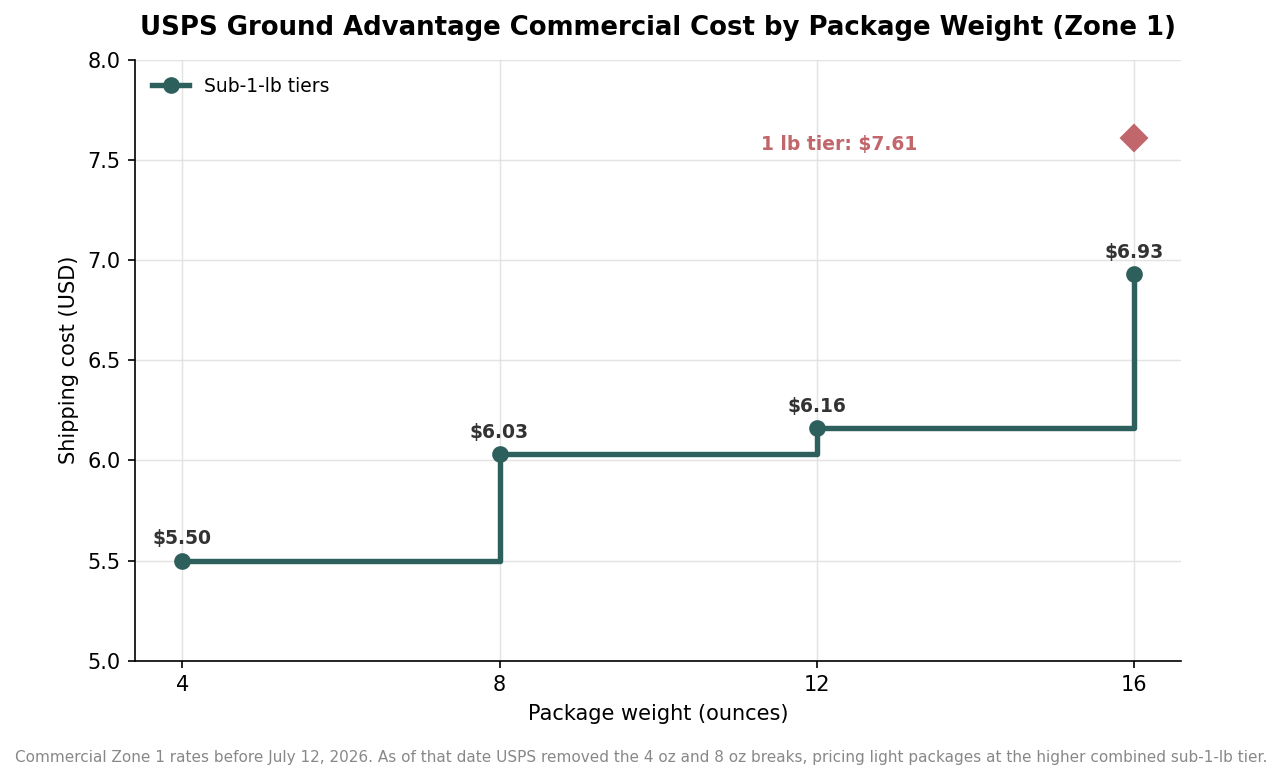
The important 2026 change: effective July 12, 2026, USPS removed the 4-ounce and 8-ounce breaks and now prices all sub-pound packages at the higher combined tier. In practice that means a light 4-ounce shipment that used to cost around $5.50 now prices at the top sub-pound rate, an increase of roughly 12 percent on lightweight parcels according to industry rate trackers. The takeaway for a mailer program is that being featherweight no longer earns the discount it once did, so the format decision matters more than shaving the last ounce.
Where a box quietly costs you more
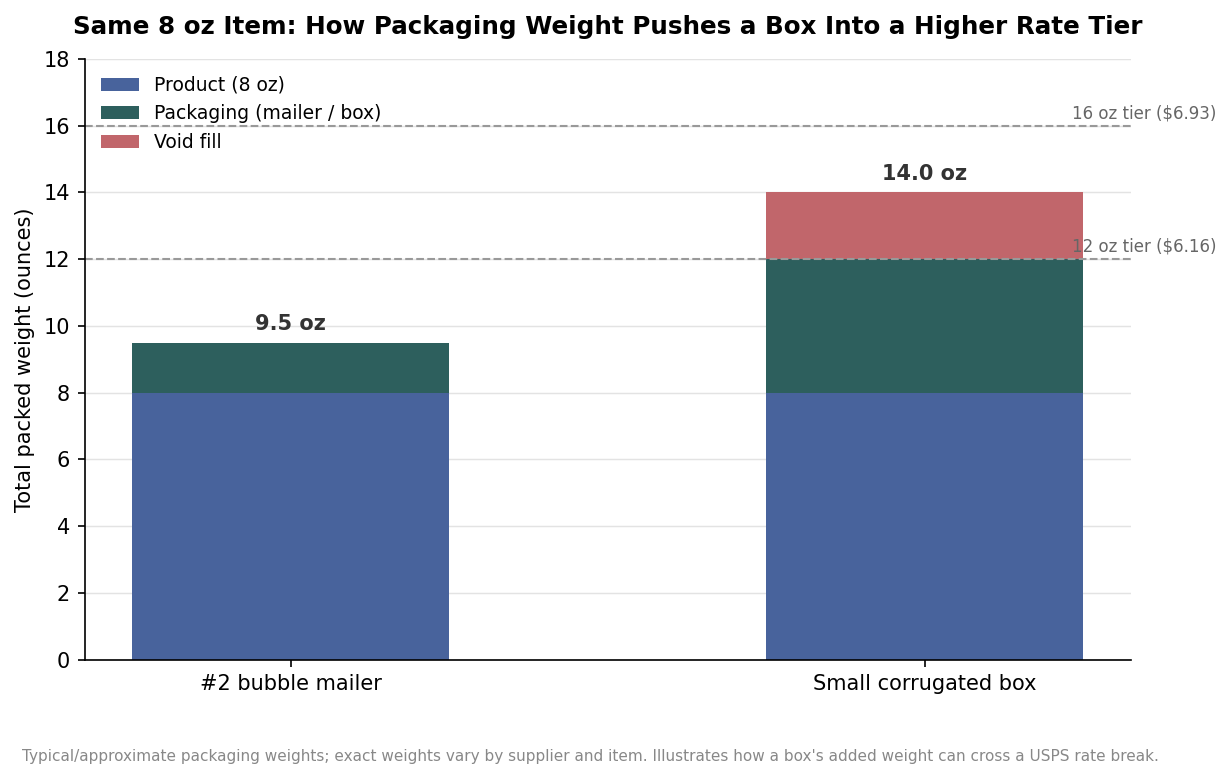
The case for a bubble mailer over a small box comes down to two hidden costs a box carries: its own weight and its volume. A flat poly bubble mailer weighs very little on its own, commonly around one to two ounces for a mid-size envelope, and it needs no void fill because the bubble lining is the cushioning. A small corrugated box starts heavier, often three to five ounces empty, and then you add paper or air pillows to keep the contents from rattling. Those ounces are not free; they can push an order across a rate break. The comparison below takes the same eight-ounce product and shows how the box lands a full tier higher purely on packaging weight.
Then there is dimensional weight, the rule that makes you pay for empty space. As of July 12, 2026, USPS also cut the dimensional divisor from 166 to 139, which raises the billable weight of bulky parcels by roughly 19 percent. Dimensional pricing kicks in once a package exceeds one cubic foot, or 1,728 cubic inches, so most small boxes stay under it, but the bigger your box the closer you get, and a lightly filled box gets billed as if it were far heavier. A bubble mailer, because it collapses around its contents, rarely runs into dimensional weight at all. For flat and semi-flexible goods, that is a structural advantage no amount of careful packing gives a box.
Reading a bubble mailer size chart
Mailers are sold by a standard number system, and matching the number to your product is how you avoid both crushed goods and wasted postage. The common interior sizes run roughly: #000 at 4 by 8 inches for jewelry and USB drives; #0 at 6 by 10 inches for cosmetics and small accessories; #2 at 8.5 by 12 inches for paperbacks, folded apparel, and phone cases; #5 at 10.5 by 16 inches for larger garments or bundled items; and #7 at 14.25 by 20 inches for the biggest soft goods. Order a size that leaves about a half inch of clearance around the product; too tight and the seal strains, too loose and the contents shift and the mailer looks sloppy on the doorstep. These dimensions are the widely used industry standard, though exact interior measurements vary a little between suppliers, so confirm against a spec sheet before printing thousands.
When a box is still the right call
None of this makes the mailer universal. Anything rigid and fragile that cannot flex, such as ceramics, framed prints, glass, or electronics with delicate housings, belongs in a box with proper cushioning, and no postage saving is worth a broken product and a return. Boxes also present better for premium unboxing, and a sturdy carton can protect a stack of items a mailer would let bend. The honest rule of thumb: if your product is flat, soft, or small and durable, a custom bubble mailer will almost always ship cheaper and take your branding just as well; if it is rigid, fragile, or heavy, price the box and build the cushioning in. Where the figures here are given as approximate, treat them as a starting point and confirm live rates for your own zones and weights, because the right format is the one that protects the product and clears the cheapest rate tier your contents allow.